Add your promotional text...
The Tale of Two Paths: Finding True Happiness in Psalm 1
Psalm 1 opens the Book of Psalms with a powerful choice: the way of the blessed and rooted tree, or the way of the scattered, worthless chaff. This post breaks down the meaning of this foundational Scripture, explores the promise of true prosperity, and offers guidance on using this psalm to set your moral compass in a turbulent world.
11/26/20254 min read


The Gateway to Wisdom: What is Psalm 1
Psalm 1 is often called the Preface or Introduction to the entire collection of 150 Psalms. It doesn’t just offer a nice piece of poetry; it lays down the moral and theological framework for understanding everything that follows. Its primary purpose is to present a profound contrast between two ways of living: the way that leads to life and blessing, and the way that leads to ruin and perishing.
The Core Question: Where Do You Plant Yourself?
This psalm asks us to decide, quite simply, where we want to be rooted. Will our foundation be the shifting sand of worldly opinion, or the eternal stream of God’s wisdom?
II. The Path of True Blessedness (Verses 1–3)
The psalm begins with the word "Blessed" (Hebrew: ’ashrê), which denotes a deep, settled, enduring happiness—a state of being fortunate and rightly positioned. This blessedness is not random luck; it is the result of deliberate choices.
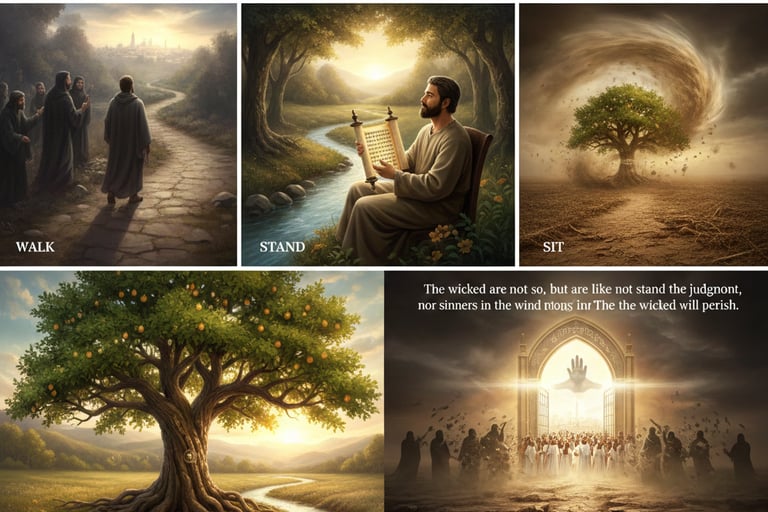
A. The Three Steps of Avoidance (Verse 1)
The righteous path begins with active rejection of negative influences. This verse details a downward slide that the wise person avoids:
Walking in the counsel of the wicked: Avoiding taking their advice or adopting their direction in life.
Standing in the way of sinners: Avoiding participation or lingering in their activities.
Sitting in the seat of scoffers: Avoiding settling down and identifying with those who mock or dismiss spiritual things.
The message is clear: association shapes character.
B. The Secret to Stability: Delighting and Meditating (Verse 2)
If the righteous person avoids the counsel of the wicked, where do they find their guidance?
...but his delight is in the law of the Lord, and on his law he meditates day and night.
The Law of the Lord (Torah) here means all of God’s instruction, wisdom, and revealed word. It’s not a burden; it’s a source of delight. This delight leads to meditation—a deep, constant contemplation and internalizing of God's word, making it the bedrock of every decision.
C. The Promise of the Rooted Tree (Verse 3)
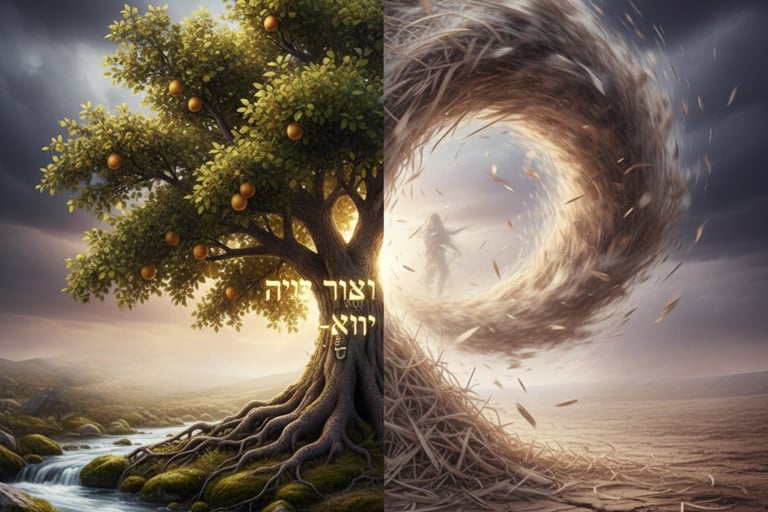
This is perhaps the most famous image in the psalm—the metaphor of the righteous person as a tree planted by streams of water.
He is like a tree planted by streams of water, that yields its fruit in its season, and its leaf does not wither. In all that he does, he prospers.
III. The Instability of the Wicked (Verses 4–6)
The contrast is sudden and stark. The wicked are not compared to a barren tree or a withered plant; they are compared to something even less substantial.
A. The Folly of Chaff (Verse 4)
The wicked are not so, but are like chaff that the wind drives away.
While the righteous are deeply rooted, the wicked are like chaff—the light, worthless husk of the grain. They lack substance, roots, and staying power. When the winds of judgment or trial come, they are easily scattered and destroyed. Their temporary earthly gains amount to nothing.
B. Judgment and Exclusion (Verse 5)
Because they are insubstantial, their destiny is one of failure in the face of eternal truth:
Therefore the wicked will not stand in the judgment, nor sinners in the congregation of the righteous.
They will find no lasting place of peace, security, or acceptance. They are excluded from the eternal community of the blessed.
C. The Reason for the Two Destinies (Verse 6)
The final verse summarizes the entire message and provides the ultimate reason for the two contrasting fates:
for the Lord knows the way of the righteous, but the way of the wicked will perish.
The Lord "knows" (approves, intimately recognizes, and protects) the path of the righteous. Their way is secure because it is secured by Him. Conversely, the entire path (derek) of the wicked, their plans, their actions, and their ultimate end, is one of perishing and oblivion.
IV. When and How to Use This Powerful Psalm
Psalm 1 is not just an ancient poem; it is a practical tool for spiritual navigation today.
For Daily Devotion: Read it every morning to set your moral compass. Ask yourself: What counsel will I absorb today? Where will I focus my delight?
Starting a New Endeavor: Use it as a prayer before starting a new job, moving, or making a major decision. It helps you prioritize God’s approval over worldly pressures.
When Facing Temptation: When you feel pulled toward shortcuts or compromise, meditate on the image of the rooted tree versus the scattered chaff. Remember which destiny you are aiming for.
Choosing Your Community: Use the "walk, stand, sit" progression as a guide for evaluating your friendships and associations. Are your chosen companions drawing you closer to wisdom or toward mockery?
Final Thought: Psalm 1 tells us that true happiness is not about what we acquire, but about what we avoid and where we are planted. Choose the streams of water, and watch your leaf stay green.
✍️ What counsel are you choosing to avoid this week? Share your thoughts in the comments below!