Add your promotional text...
Fasting During Carême: Embrace the Season
Explore the significance of fasting during Carême, a season that invites us into the desert with Christ. Discover how this practice creates space for silence, prayer, and a deeper connection with God during Lent.
2/19/20263 min temps de lecture
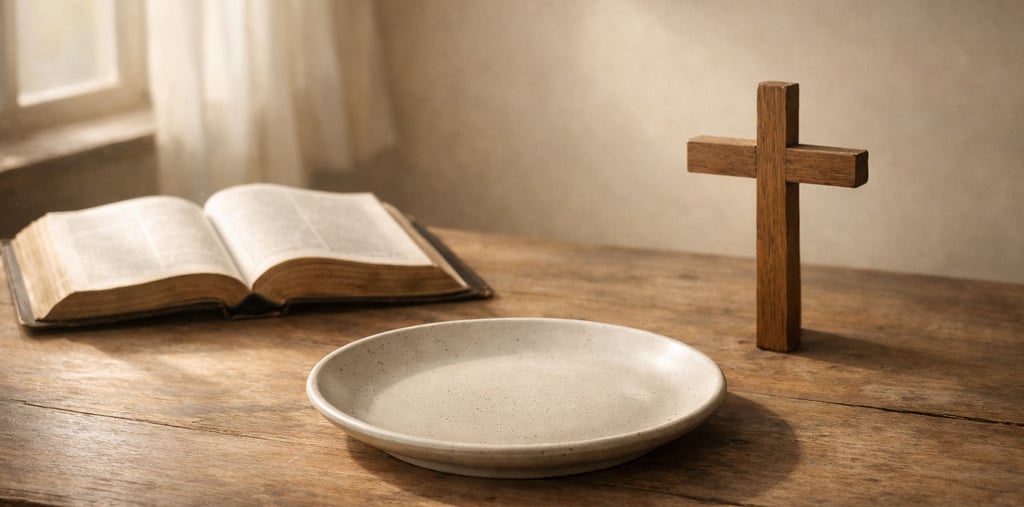
fasting without harshness
Fasting is one of the most misunderstood practices of Lent. Many see it only as restriction, yet at its heart, fasting is an act of trust. It is a way of saying: God, You are enough.
“Man shall not live by bread alone, but by every word that comes from the mouth of God.”
— Matthew 4:4
The Spiritual Meaning of Fasting
Fasting during Carême is not about perfection or endurance. It is about awareness — becoming conscious of what fills our lives and what distracts us from God.
When we fast, we gently loosen our grip on what we rely on too heavily, so that our hearts may rely more fully on God.
“Return to me with all your heart.”
— Joel 2:12
Fasting becomes prayer when it is offered with humility and love.

Fasting Beyond Food
While food fasting is part of Carême, the Church also invites us to fast in ways that touch the heart more deeply.
You may consider fasting from:
Excess screen time
Complaints or harsh words
Hurry and constant noise
Judgement or impatience
These forms of fasting can be challenging, but they often bear great spiritual fruit.
“Create in me a clean heart, O God.”
— Psalm 51:10
Choosing a meaningful fast helps us become more attentive — to God, to others, and to ourselves.
Replacing What We Give Up
A healthy fast is never empty. What we give up should be gently replaced with something that draws us closer to God.
For example:
Replace social media with Scripture reading
Replace late-night distractions with quiet prayer
Replace unnecessary spending with generosity
Some find it helpful to keep a small prayer reminder, such as a rosary or devotional card, nearby during moments of temptation or distraction — not as a solution, but as a gentle invitation back to prayer.


Fasting and Interior Freedom
At its best, fasting leads to freedom. It reveals what controls us and gently teaches us to let go.
“For freedom Christ has set us free.”
— Galatians 5:1
During Carême, fasting may uncover restlessness, impatience, or resistance. These moments are not failures — they are invitations. Invitations to surrender more deeply and to trust God’s grace.
If fasting feels difficult, begin again gently. God sees the intention of the heart.
When Fasting Feels Hard
There may be days during Carême when fasting feels heavy or discouraging. On those days, remember: fasting is not about achievement.
“My grace is sufficient for you.”
— 2 Corinthians 12:9
If you struggle:
Simplify your fast
Offer your difficulty as prayer
Rest in silence rather than striving
Even the desire to fast, when offered sincerely, pleases God.
Fasting as Preparation for Easter
Carême leads us toward joy. Fasting prepares the soil of the heart so that Easter may take root more deeply within us.
By letting go, we make room — room for resurrection, renewal, and hope.
“Those who sow in tears shall reap with shouts of joy.”
— Psalm 126:5
Closing Reflection.
Fasting during Carême is not about loss, but about love. Love that chooses God again and again, even in small, hidden ways.
As you continue your Lenten journey, fast gently, pray faithfully, and trust that God is at work — even in silence.
A Short Prayer
Lord,
teach me to fast with humility and trust.
Help me let go of what distracts me from You,
and fill the empty spaces of my heart
with Your presence and peace. Amen.
👉 Blog #1: How to Prepare Your Heart for Carême