Add your promotional text...
The Weight of Love: Charity and Mercy as the Heart Lent
An exploration of why charity and mercy are the true fulfillment of Lenten fasting. This post examines how Scripture calls us to transform our inner sacrifices into tangible acts of love and solidarity.
3/17/20263 min temps de lecture


The forty days of Carême, or Lent, are often defined by the quiet rhythm of internal discipline. We draw inward. We count our fasts. We focus on pruning our own behaviors to turn our hearts back toward the Divine.
However, if we remain locked in this vertical gaze, we risk missing the very point of the pruning. The Prophet Isaiah provides the ultimate "reality check" for those who fast without love:
"Is not this the fast that I choose: to loose the bonds of wickedness, to undo the straps of the yoke, to let the oppressed go free... Is it not to share your bread with the hungry and bring the homeless poor into your house?" — Isaiah 58:6-7
The true meaning of Lent is not fulfilled in the private "fullness" of our perfect sacrifices. It is fulfilled when our inner emptiness becomes a vessel of mercy for our neighbor.
hope and accompaniment.
The Triad: A Perfect Geometry of Love.
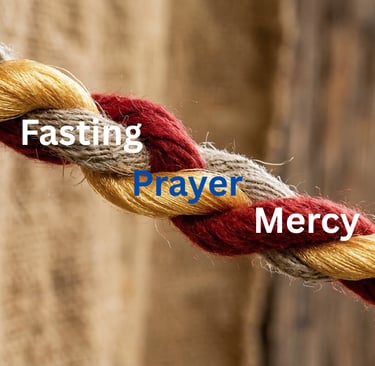
The liturgical triad of Lent—Fasting, Prayer, and Almsgiving—is not a list of three separate tasks. It is a single, integrated movement of the soul. Fasting thins the ego; prayer opens the ear; but charity is the hands that turn sacrifice into sacrament.
Fasting without charity is spiritually hollow. In the New Testament, James is clear that faith—even the disciplined faith of a Lenten faster—is dead if it does not move toward the needs of others:
"If a brother or sister is poorly clothed and lacking in daily food, and one of you says to them, 'Go in peace, be warmed and filled,' without giving them the things needed for the body, what good is that?" — James 2:15-16
Fasting creates the physical and mental space by stripping away our comforts. Charity is the act of placing that newly available space—and the resources saved—at the service of others.
Mercy: The Heart of the Father.
If charity is the act of giving, mercy is the heart that motivates it. During Carême, we seek to imitate the heart of the Father, who is described throughout Scripture as "rich in mercy."
Jesus frequently reminded His followers that religious ritual is secondary to the condition of the heart toward others. He quoted the prophets saying:
"Go and learn what this means: ‘I desire mercy, and not sacrifice.’" — Matthew 9:13
Lenten mercy is the profound capacity to be moved by the suffering of another. It is a call to move from seeing people as "problems to be solved" to seeing them as the "image of God." When we extend mercy, we are not performing a duty; we are participating in the nature of God Himself.
The Power of Compassion
This kind of Mercy is not a sentimental feeling; it is raw and physical. It requires us to step out of our "desert" and into the lives of those around us.


The Gospel of Matthew provides the standard by which our Lenten efforts will ultimately be measured. It is a sobering reminder that our relationship with the Divine is mirrored in our relationship with the vulnerable:
"For I was hungry and you gave me food, I was thirsty and you gave me drink, I was a stranger and you welcomed me... as you did it to one of the least of these my brothers, you did it to me." — Matthew 25:35, 40
In this light, almsgiving is not just "giving to the poor." It is a direct encounter with Christ.
Vertical Grace Becomes Horizontal Love
Finally, the Lenten journey of mercy forces us to confront our own need for grace. We cannot give what we have not received. We are called to be merciful because we have been shown mercy.
"Be kind to one another, tenderhearted, forgiving one another, as God in Christ forgave you." — Ephesians 4:32
The vertical current of grace that allows us to receive forgiveness from God must become a horizontal current toward our neighbors. Mercy is the hard work of releasing grievances and dismantling the ledgers of blame we have held against others.
Conclusion: The Final Feast
As we near the celebration of Pâques (Easter), we realize that the entire purpose of the season has been to prepare our hearts for joy. But it is a collective joy. We cannot truly appreciate the Resurrection while ignoring the "crucifixions" happening in the lives of the poor and lonely around us.
This Carême, make your fast a prayer and your prayer a catalyst for love. Discover the profound reality that when we pour ourselves out in acts of mercy, we are not diminished. Instead, we are finally made full.
"Give, and it will be given to you. Good measure, pressed down, shaken together, running over, will be put into your lap." — Luke 6:38